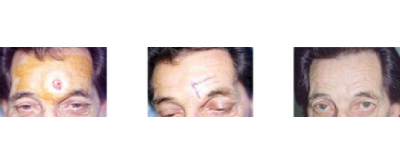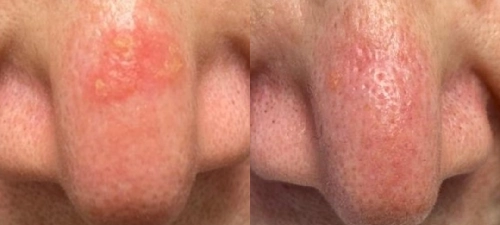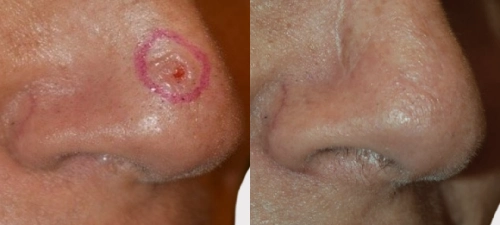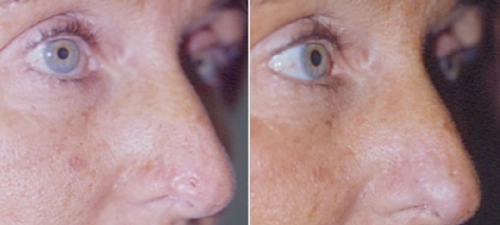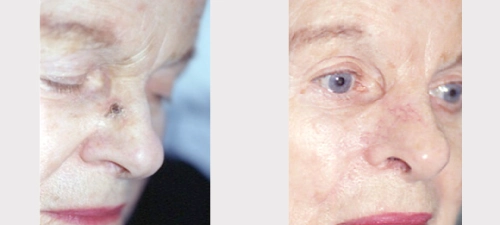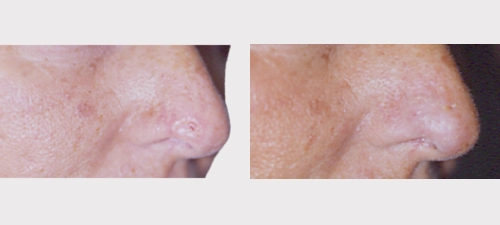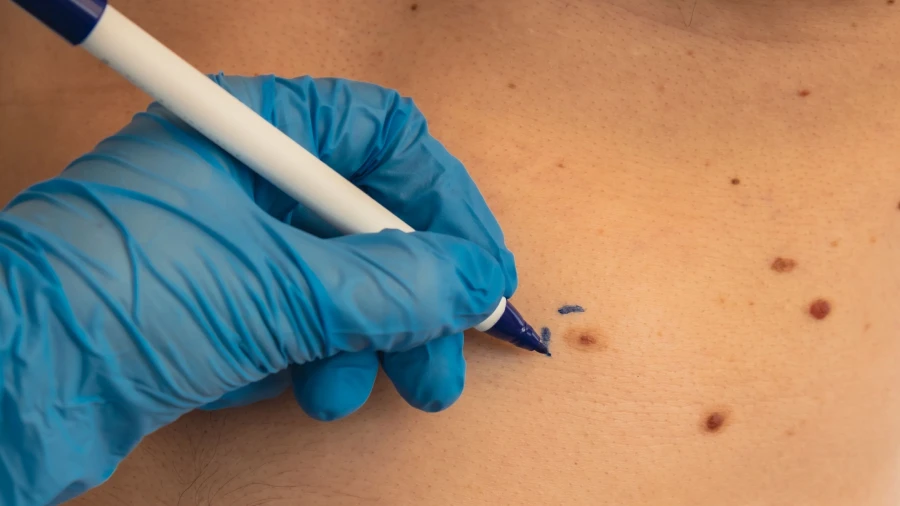
Dr Touma has the longest experience in treating skin cancer in the Middle East. He has performed over 10 000 procedures from surgery to laser to non surgical procedures, customized to obtain maximum cure rates aesthetic and functional results,
Skin cancer is the most common form of cancer worldwide, and its incidence continues to rise, including across the Middle East. It develops when skin cells grow abnormally and multiply uncontrollably. The three main types are basal cell carcinoma, squamous cell carcinoma, and melanoma, each with different levels of severity and risk.
Understanding the Skin
The skin is the body’s largest organ, protecting us from injury, infection, and dehydration. It has three main layers:
- Epidermis: the outer protective layer
- Dermis: the middle connective layer with glands and nerves
- Subcutaneous fat: the deepest layer for insulation
Skin cancer arises when abnormal cells form in the epidermis due to factors like sun damage, genetics, or radiation exposure.
Main Types of Skin Cancer
Basal Cell Carcinoma (BCC)
- Represents about 75% of all skin cancers
- Usually appears on the face, neck, or trunk
- Slow-growing and rarely spreads, but can invade nearby tissue if untreated
- Recurrence is common, about 35% of patients develop another within five years
Squamous Cell Carcinoma (SCC)
- Makes up about 20% of skin cancers
- Develops on sun-exposed areas such as the face, ears, lips, or hands
- More aggressive than BCC, with a higher chance of spreading to lymph nodes or deeper tissue
- Early detection leads to excellent outcomes
Melanoma
- The most serious form of skin cancer
- Starts in pigment-producing cells (melanocytes)
- Can appear anywhere on the body, including moles
- Early diagnosis is lifesaving, as melanoma spreads quickly if untreated
- Accounts for only 5% of skin cancers, but causes 75% of deaths
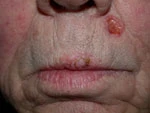
Basal cell Carcinoma of the left upper lip coexisting with Squamous cell carcinoma of the mid lip
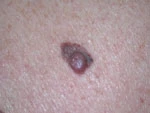
Malignant melanoma
Precancerous Skin Conditions
Actinic (Solar) Keratoses are rough, scaly patches caused by chronic sun exposure. While most remain benign, some can progress into squamous cell carcinoma. Treatment options include:
- Cryotherapy (freezing)
- Laser resurfacing
- Photodynamic therapy (PDT), proven effective in studies led by Dr. Dany Touma for diffuse actinic damage and keratoses.
Risk Factors for Skin Cancer
You are at higher risk if you:
- Have fair skin, light hair, or light eyes
- Spend significant time in the sun or tanning booths
- Have a history of severe sunburns, especially in childhood
- Have multiple or atypical moles (dysplastic nevi)
- Have a family history of melanoma
- Work outdoors or receive frequent X-ray exposure
Prevention tips:
- Avoid sun exposure between 10 a.m. and 3 p.m.
- Use broad-spectrum sunscreen SPF 30+ daily
- Wear protective clothing and wide-brimmed hats
- Avoid tanning beds
Warning Signs of Skin Cancer
Check your skin regularly and consult a dermatologist if you notice:
- A new growth, sore, or patch that doesn’t heal
- A mole that changes in size, color, or shape
- Persistent itching, bleeding, or crusting
Use the ABCD rule for melanoma detection:
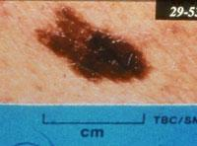
A – Asymmetry | B – Border irregularity | C – Color variation | D – Diameter >6mm
Atypical nevus. Note large size, irregular border and color
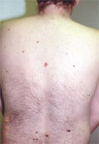
Patient with multiple atypical nevi
Diagnosis
Diagnosis begins with a clinical examination and skin biopsy. The sample is analyzed under a microscope to confirm the type and depth of the cancer.
At our clinic, most biopsies and minor excisions are performed under local anesthesia with minimal downtime.
Treatment Options
Treatment depends on the cancer type, size, and location. Options include:
- Excisional surgery, removal of the cancerous tissue, including MOHS micrographic surgery
- Cryosurgery, freezing abnormal cells
- Electrodesiccation, using heat to destroy cancer cells
- Topical immunotherapy creams, for superficial cases
- Radiation therapy, for select advanced cases
Mohs Micrographic Surgery
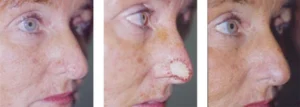
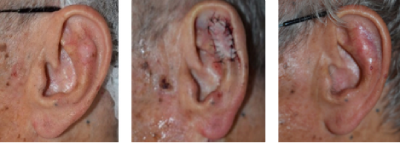
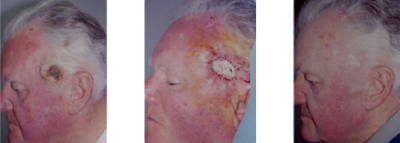
For delicate facial areas or recurrent cases, Mohs surgery is the gold standard. It removes cancer layer by layer under microscopic control, preserving healthy tissue and offering the highest cure rate with minimal scarring.
Dr. Dany Touma has the largest experience in Mohs surgery in the Middle East, having successfully treated over 10,000 cases. He also specializes in cosmetic skin reconstruction following tumor removal.
Melanoma Surgery
Melanoma is treated surgically, often with wider excision margins and, in some cases, sentinel lymph node biopsy to check for spread. Early-stage melanoma is often curable with surgery alone.
Follow-Up and Prevention
Regular dermatological check-ups are essential even after treatment.
Patients should:
- Examine their skin every 6-8 weeks
- Attend scheduled follow-up visits
- Maintain sun protection habits
- Adopt a healthy lifestyle, exercise, quit smoking, reduce sugar intake, and monitor for other cancers
When detected early, basal and squamous cell cancers have a 99% cure rate. Melanoma survival exceeds 90% in early stages but decreases sharply if it spreads, making early diagnosis and prevention key.
Protect Your Skin. Protect Your Health.
If you notice any suspicious moles, spots, or lesions, book a consultation with Dr. Dany Touma and his team od expert dermatologists for expert evaluation and treatment using advanced diagnostic and surgical techniques.